A service business rarely loses customers because it cannot answer a question. It loses them in the gaps: slow confirmations, missed follow ups, payment chasing, reschedules that turn into silence. If your AI ends with “here is a link” it is not solving the problem. It is moving the admin elsewhere.
A chatbot is typically:
One interface, one agent
Designed for information and triage
Driven by scripted flows, FAQ content or a narrow set of intents
Measured by deflection and time to answer
Detached from the real operational system of record
In practice, chatbots often do this:
“Here are our prices”
“Here is our booking link”
“Here are our opening hours”
“I have handed you to a human”
That is useful, but it is not the job.
Why chatbots break down in service businesses
Service businesses have a few realities that chatbots struggle with:
The customer journey is a loop, not a one off question
A booking is a chain of commitments: time, location, provider, price, payment method, policies
Reschedules and late cancellations are normal, not edge cases
The business needs certainty: confirmed sessions, completed payments, an audit trail
When a bot is not connected to operations, it becomes a polite dead end:
It can answer, but it cannot complete
It can suggest, but it cannot coordinate
It can talk, but it cannot take responsibility
What we mean by an “AI workforce”
An AI workforce is not one bot. It is a team of specialised agents that run the operational loop in chat.
With AllSet, that means:
The customer stays in one thread
The business runs through one number
Agents coordinate bookings, changes, reminders and payments end to end
Context is carried forward so the customer does not repeat themselves
The business gets the outcome, not another message to handle
If a chatbot is a front desk greeter, an AI workforce is the front desk team.
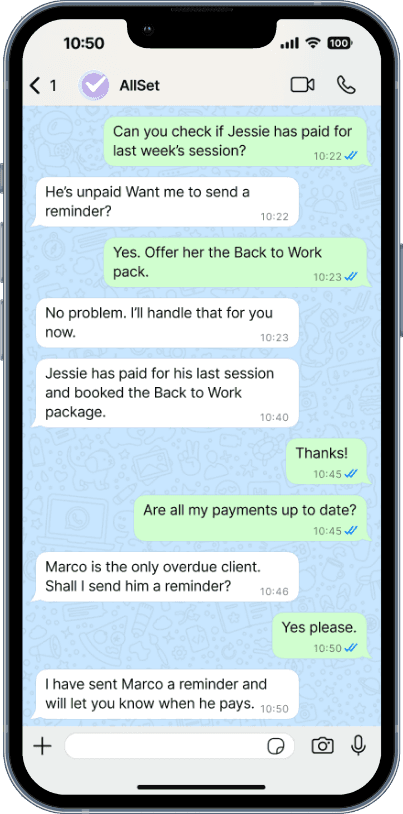
The simplest test: can it complete the job without handholding?
Here is a practical way to tell the difference.
Ask your AI to do these tasks, end to end, in one conversation:
Book a session for next week at a specific time
Offer the nearest alternatives if that time is not available
Confirm the booking clearly in chat
Take a deposit or full payment
Send an automatic reminder at the right time
Handle a reschedule without losing the payment status
Record what happened so the business can see it later
Follow up after the session to rebook
A chatbot will usually fail at one of these steps because it does not own the workflow.
An AI workforce is built for the workflow.
What makes an AI workforce different in practice
1. Multi step work, not single answers
Service operations are a series of linked actions.
AllSet agents can move from:
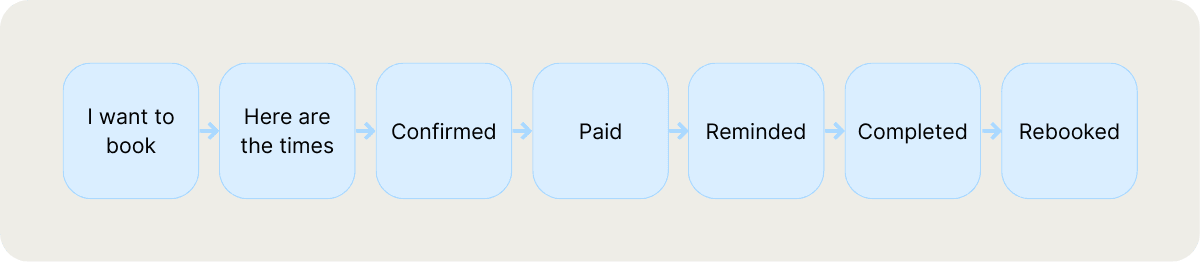
All in the same thread, without asking you to switch tools.
2. Context that persists
Customers should not have to repeat:
What they want
Who they are booking with
What they paid last time
What time they prefer
What happened in the last conversation
AllSet is designed so context carries forward inside the chat journey, which is how you get speed without confusion.
3. Operational ownership, not “handoff to a human”
Most systems use “handoff” as the safety net. In reality, handoff is the cost centre. It is the part that drags you back into admin An AI workforce is built to handle the normal cases fully, then escalate only when it should.
That is how you protect the owner’s time.
4. Built around outcomes that matter
The metrics are different.
Chatbots optimise for:
Conversations handled
Tickets deflected
Response time
A service business needs:
Sessions confirmed
No shows reduced
Payments completed
Capacity filled
Repeat bookings driven
AllSet is built around those operational outcomes because that is what keeps the business stable and growing.
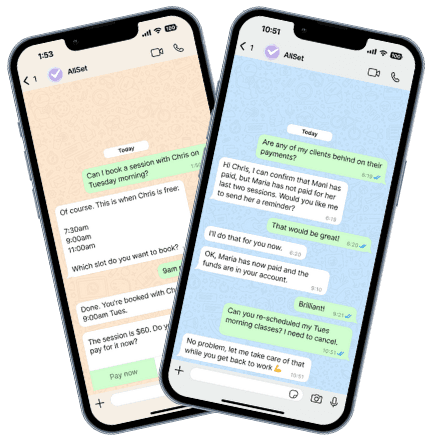
A simple example: booking in chat, the right way
A chatbot experience often looks like:
Customer: “Can I book Tuesday?”
Bot: “Here is a link”
Customer: opens link, drops off or cannot find the right slot
Business: follows up manually, late, inconsistently
An AI workforce experience should look like:
Customer: “Can I book Tuesday after work?”
AllSet: offers two or three suitable times
Customer: picks one
AllSet: confirms the session and takes payment if required
AllSet: sends a reminder at the right time
AllSet: follows up after to rebook
One thread. One number. No switching. No chasing.
Why “AI workforce” matters now
Service expectations have changed.
People reply to messages faster than they fill forms. They want certainty quickly. They assume reschedules will be easy. They expect payment to be simple.
At the same time, most service businesses are still trying to run on:
booking tools
payment links
notes
spreadsheets
missed calls
scattered message threads
The gap between expectation and operations shows up as:
slower confirmations
more awkward payment chasing
more admin, less time on delivery
An AI workforce closes that gap by making chat the operating layer.
What to look for if you are choosing a solution
If you are evaluating “AI in chat” tools, look for these signals.
An AI workforce solution should:
Keep the customer in one conversation
Handle bookings, changes and payments without sending people elsewhere
Make reminders and follow ups automatic
Provide visibility, not just messaging
Reduce manual touch, not just response time
Feel calm and human, not robotic and verbose
If it is mostly a chat interface on top of your old process, it is still a chatbot.
The AllSet approach
AllSet harnesses proprietary AI to run service businesses in chat.
It is designed as an AI workforce that coordinates bookings, changes, reminders and payments through one WhatsApp number so you can stay consistent, visible and growing without effort.
If you want to see the difference in practice:
Or talk to us about a partner rollout with revenue share and affiliate options where it fits